Planting Plans
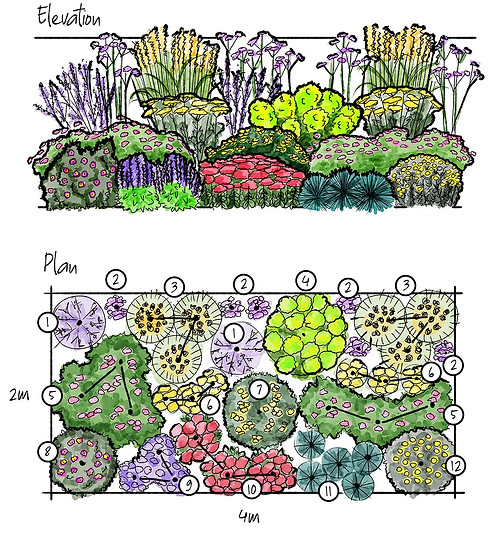
The planting plan stage of garden landscaping is where the design vision is translated into a detailed, practical scheme that shows exactly what will be planted, where, and in what quantities. This stage ensures the garden will develop as intended and can be clearly understood by contractors and clients. It typically includes the following:

1. Developing the planting layout
Plant positions are set out accurately on a scaled plan, showing the arrangement of trees, shrubs, perennials, grasses, bulbs, and groundcover. Spacing is carefully considered to allow plants to establish and mature without overcrowding.
2. Selecting appropriate plants
Plants are chosen to suit the site conditions identified earlier, such as soil type, drainage, aspect, and microclimate. Consideration is also given to the desired style, colour palette, seasonal interest, and long-term maintenance requirements.
3. Structuring the planting
The plan establishes a clear planting structure, often using trees and large shrubs for framework, with smaller shrubs, perennials, and grasses providing texture, movement, and seasonal variation.
4. Noting quantities & sizes
Each plant is labelled or keyed to a plant schedule that lists botanical names, sizes at planting, pot or root types, and quantities. This allows accurate pricing, ordering, and installation.
5. Considering year-round interest
& ecology
The planting plan balances flowering periods, foliage interest, and structure across the seasons, while also supporting biodiversity through nectar-rich, wildlife-friendly species.
6. Coordinating with hard landscaping
Planting is designed in relation to paths, patios, walls, and other built features, ensuring adequate clearances, sightlines, and ease of maintenance.
7. Providing supporting information
The planting plan may be accompanied by notes on soil preparation, mulching, irrigation, staking, and establishment care to ensure successful growth.
The planting plan stage results in a clear, build-ready document that communicates the planting design precisely, helping the garden mature into the intended design over time.
Drought-Tolerant
Planting Scheme
As the UK climate continues to change, it is increasingly important to select plants that can cope with hot, dry summers. This is particularly relevant in the south of England, where hosepipe bans are becoming more common and winters are generally milder.
Many drought-tolerant plants originate from Mediterranean regions and naturally thrive together, as they are adapted to the same environmental conditions. When planted in combination, they form cohesive and visually harmonious planting schemes.
These plants share a number of distinctive characteristics. Many have aromatic grey-green or silver foliage that reflects sunlight, while others have hairy leaves and stems or a waxy outer coating to reduce water loss through transpiration. Deep and branching root systems allow them to access moisture from lower soil levels.
Drought-tolerant gardens are highly beneficial as they are typically low maintenance, requiring little watering once established. In addition, many of these plants are rich sources of nectar and pollen, supporting bees and other pollinating insects.
Maintenance can be reduced further by creating a gravel garden. This involves laying a weed-suppressing membrane over the soil and topping it with a moisture-retentive gravel mulch. Such borders are ideal for sunny, well-drained areas with low-fertility soils.